29 July 2014

How to Make a Bow Back Nettie


It's no secret that I love bows. And the Nettie pattern from Closet Case Files was just screaming out for a bow addition to that lovely scoop back. As promised in my previous post, I'm going to share with you how how I made this variation. Full disclosure - I totally ripped off this idea from a top by Louche that I have in my wardrobe (bought from Joy - love that shop). I'd tried to buy the same style in different colours from them, alas they were all too big for me at the shoulders and back. Hurrah for making it myself!


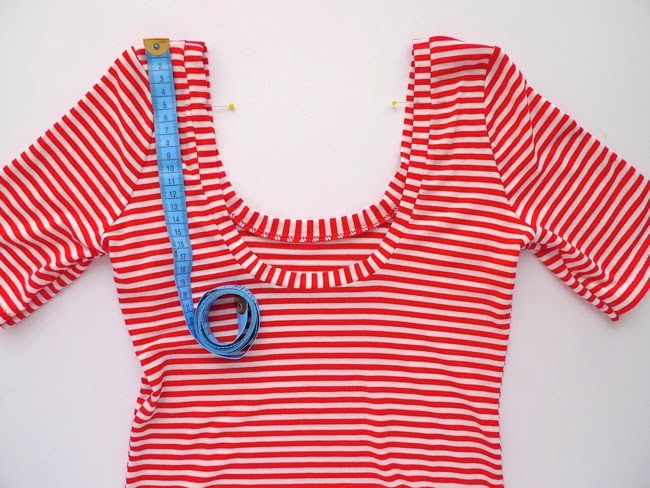
1) Make a scoop back Nettie, using Heather's wonderful instructions (the pattern is for a body suit or dress, but I just made it into a top). Decide where abouts on the back you want the top of your bow to sit and place pins in either side of the scoop back at this point - for reference, the top of my bow lies 5cm (2in) down from the shoulder seams. Measure the width between these two points across the scoop.


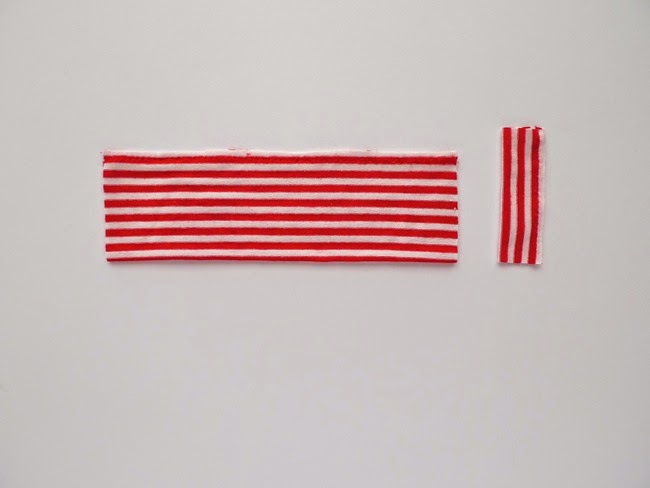
2) To make the bow, cut a piece of stretchy jersey fabric the width of [the measurement you just took + 3cm (1 1/4in)] x 14cm (5 1/2in) length/depth.

Now cut the knot piece that will go around the centre of the bow - 5cm (2in) wide x 8cm (3 1/4in) long/deep.


3) Fold the bow in half, right sides together, bringing together the longest edges. Pin them together and zigzag stitch. Now fold your knot in half, right sides together, bringing the longest edges together. Pin and zigzag stitch.


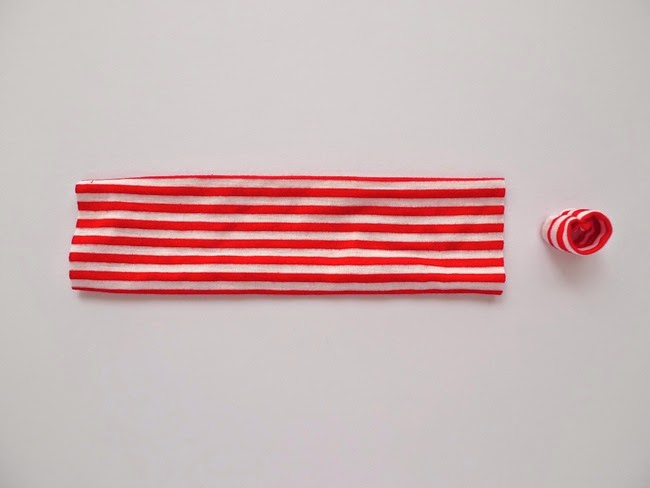
4) Turn the bow and knot pieces right sides out. Fold the bow in half the other way, bringing the short edges together, with the seam line on the outside of the loop. Zigzag stitch the short edges together.


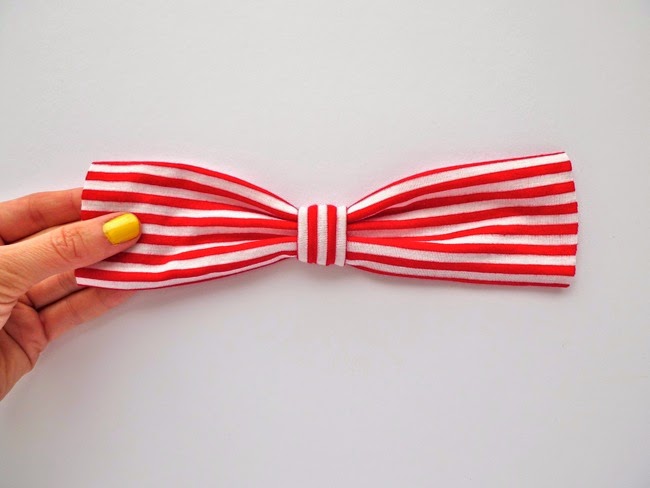
5) Slip the knot over the bow, positioning it in the centre, with the seam lines on both the knot and bow at the centre back. If you want to, you can secure the knot to the bow with a couple of hand stitches.


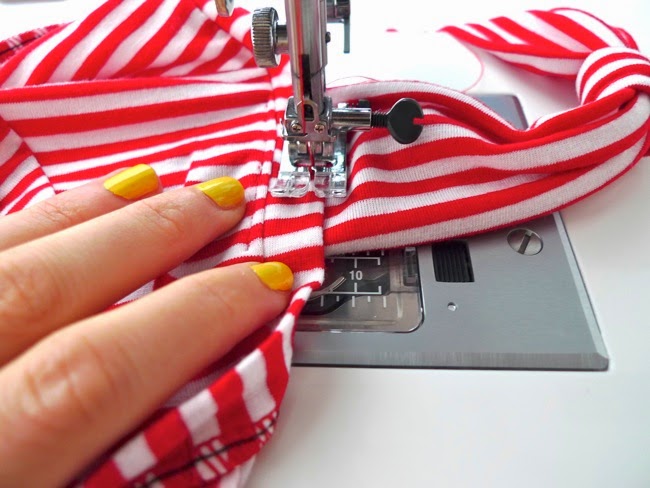
6) Turn your Nettie inside out. Line up the raw edges of the bow with the inside seam of the neckband just below your pin markings. Make sure the seam lines of the bow are facing up so they end up on the inside of the top. Try your Nettie on (be careful with the pins, obvs!) and check you're happy with the positioning of the bow. Depending on how stretchy your fabric is (and if you're using the same fabric as the top), you may also want to adjust how tightly the bow sits across your back (the bow will stretch when you wear it, as will the scoop of the back).


7) Once you're happy with the positioning of the bow, straight stitch the bow to the neckband using two parallel rows of stitching.


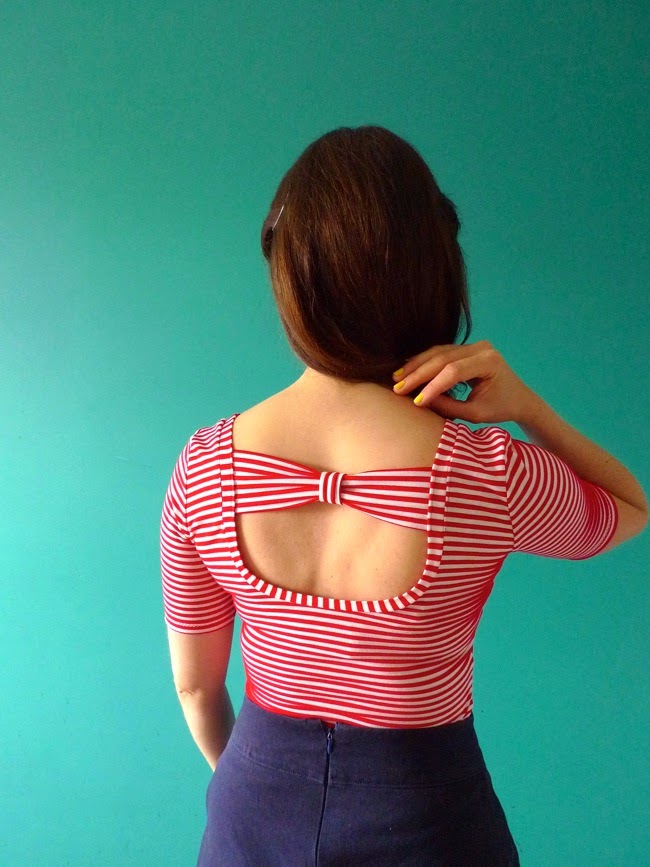
And there you have it! A lovely bow back Nettie for you to enjoy. Be sure to let me (and Heather!) know if you make one!

22 July 2014

Bow Back Nettie


Oops I did it again. I made another Nettie top (here's my first one). It's got stripes on it, surprisingly enough.

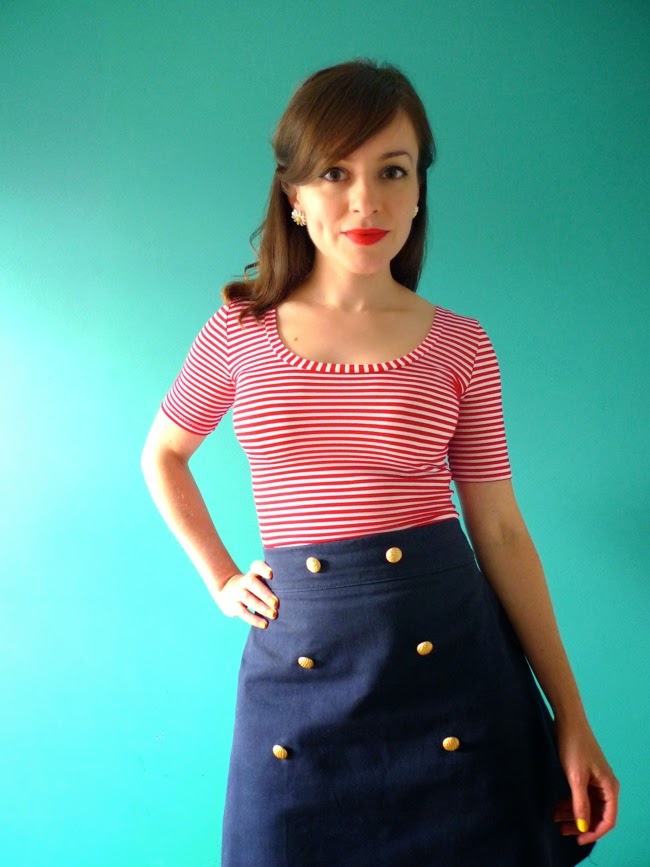
This time I lengthened the sleeves and, since I find my bra straps keep peeping out at the back when I wear the first version, I brought the sides of the scoop back in a little. I think the fabric is from a shop on Goldhawk Road. Today I'm wearing Nettie with my favourite Delphine skirt, from Love at First Stitch - a match made in nautical heaven.


Oh yes, and it has a bow at the back! I'm going to share a little tutorial soon on how to make the bow, if you want to make one yourself. (Just in case you're wondering whether I really do have a beefcake body builder back as this photo would suggest, no. I do not. It was surprisingly difficult to get the angle right on this photo!)


What have you been sewing, please?

[Soundtrack: 'Somebody Else's Guy' by Jocelyn Brown]

15 July 2014

When Nettie Met Miette

 Nettie top sewn by Tilly and the Buttons
 Nettie top sewn by Tilly and the Buttons

Have you made the Nettie pattern by Closet Case Files? I'm in love! I think she makes the perfect partner to my Miette skirt, not just because of the tongue twister name combo, but because of the way the tight silhouette on top is balanced out with the flared skirt. Seventies loveliness, right there.

Nettie is a print-at-home pattern for a very figure hugging dress or body to be made in stretchy jersey (named after the gorgeous Wanette from Sown Brooklyn!). When I say "body", I'm talking about those things with poppers down below that we sported in the early 90s. I distinctly remember being impressed with my friend Emma Viner's crushed velvet body from M&S that she wore to the school disco. M&S seemed posh in those days, to me at least, and a crushed velvet body? The height of sophistication, particularly in contrast to my own school disco ensemble of carpet waistcoat, denim shirt and leggings. Wait... what was I talking about? Oh yeah, so the pattern is for a tight dress or body, but I prefer wearing less clingy stuff on my bootiful lower half and don't like the idea of a body cutting into said booty, as fashionable as they may be, so I redrew the bottom of the pattern to create a simple top instead.

 Nettie top sewn by Tilly and the Buttons

You get the choice of three different necklines front and back - I went for the scoop neck front and medium scoop back. Because of my petite frame, I raised the front neckline by 1cm, as well as shortening the bodice. I'd read that the shoulders on the pattern were narrow, which is perfect for me as it saved me a job. I also raised the medium scoop back by 2cm because I was paranoid about my bra showing. However, I needn't have worried, it is well covered - next time I'll use Heather's original cutting line for the back, she knew what she was doing. The sleeves ended up being a bit tight on me though, which is something I find quite often happens - I'm clearly doing too much body building. (Not.) Apart from that, fitting jersey is so easy as the stretch basically... well, stretches over the bits you need it too. I was slightly concerned about just how tight it ended up being, but my caring boyfriend reassured me that "there's no such thing as too tight". He's a big fan of Nettie. Soooo predictable.

 Nettie top sewn by Tilly and the Buttons
 Nettie top sewn by Tilly and the Buttons

Cutting stretchy jersey is, let's face it, a bit of a pain, as it wriggles all over the place and you need to be careful not to stretch it out of shape while you're trying to get it to play ball. Once I'd cut it out, the pattern came together very quickly and relatively easily, stitching it on a combination of my lovely sewing machine and overlocker. If you're a relatively new stitcher, you may find stretchy jersey a bit of a challenge, so I'd advise you to start with a low stretch knits pattern first. If you've mastered something like Coco and are ready for the next level, try Nettie! She's a good girl. You'll love 'er. I do.

[Soundtrack: 'Rumble' by Kelis]

8 July 2014

A Summery Short Sleeved Coco Hack


I know I say this every time, but I think this is my favourite thing I've ever made.

It is, bien sûr, the Coco sewing pattern, this time with both a contrast yoke and short sleeves. You may recognise the fabrics - the yoke and sleeves are made from leftover fabric from my turquoise funnel neck Coco top, the bodice and pockets are from the striped dress with yellow pockets, both of which feature on the Coco pattern cover. Just like my Sixties Stripe Coco top, I decided to position the pockets so the stripes are vertical - I love how the contrast directional stripes look together (was that a sentence?).

If you want to make your own Coco dresses and tops for Summer, it's super easy to shorten the sleeve pattern.


First, decide how long you want the sleeves - you can measure down an existing top, from the armpit to where you want the sleeve hem to fall, then add 3.5cm (1 3/8in) to account for the seam allowance and hem allowance. (My short sleeves are 15cm [6in] long, including seam and hem allowance.) Using a tape measure standing on its side, measure down both underarm seam lines on the Coco sleeve pattern (on the lines corresponding to your pattern size) and mark the length of your sleeve. Standing the tape measure on its side, rather than laying it flat, will allow you to bend it to measure the curved line more accurately.


Using a pattern master, set square or similar tool with a 90 degree angle, draw a short line, about 1.5 - 2cm (5/8 - 6/8in), at right angles from each of these markings.


Then, using a curved ruler (or a gentle hand), draw a very very slight curve for a few cm up and away from these lines, and connect up the curved lines with a straight line. You should end up with a smooth, very slight concave curve, with the ends at right angles to the underarm seam lines. The reason you want this shape rather than a simple straight line is that the ends of the line need square corners so that, when you sew the underarm seam, they match up nicely without any weird angles in the seam allowance.


And that's it! Cut out your sleeves using your new pattern and sew them to the bodice as normal.


Hmm... now I'm thinking about making another one...

4 July 2014

How to Sew a Skirt Lining


Want to add a lining to your homemade skirt? This is the super simple method I used for attaching a lining to my Echino Stag Delphine Skirt. There are lots of different ways of going about making and stitching a skirt lining, and this is the one I prefer – firstly because it makes sense in my brain, secondly because it doesn’t involve any hand stitching, hooray!

So why would you want to line a skirt? I decided to add a silky smooth lining to the inside of my skirt because I didn’t want the rough canvas fabric rubbing against my skin. Also, short skirts can cling to your legs and ride up a bit, so adding a lining can help make the outer layer of fabric behave properly – and thus avoid flashing your bum to the world. And while it does take a bit of extra effort, lining a skirt means you don’t need to finish the seam allowances – it’ll hide them for you, woop!

I’m sewing the Delphine skirt which is a pattern included with my book, Love at First Stitch. You can also use this tutorial for sewing similar skirt designs that have a waistband, side seams and invisible zip at the back. Oh and no darts – if your skirt has darts, you just need to pleat the top of the darts in the lining rather than sewing along the dart legs (there are tutorials online which will show you how).

What fabric can you use to line a skirt? All sorts. I’m using a… well actually I don’t know what it is exactly, but it was called “lining fabric” in the shop! Go for something lightweight, smooth to the touch, with drape – such as silks, silky polyesters or even a very lightweight cotton. Remember to change your sewing machine needle to a size appropriate for the lining fabric you’re using (ie. probably something quite fine).

Let’s do this!


Sew the skirt side seams, waistband, zip and back seam – up to step 8 if you’re making the Delphine skirt from Love at First Stitch. There’s no need to finish the seam allowances unless your fabric is seriously fraying, as the lining will hide them, but do trim and press the seam allowances open.


Cut the lining fabric using the same pattern pieces you used to cut the front and back skirt. Trim the hem of each piece down by about 2.5cm (1in) – this will stop the lining from peeping out when you wear the skirt. Stitch the side seams of the lining pieces, right sides together, the same way as you sewed the skirt. Again, you can finish the seam allowances if you like but I find this adds unnecessary bulk so don’t bother any more. Press the seam allowances open.


Now we need to stitch the bottom of the centre back seam, leaving an opening for the zip. Measure the zip from the seam where it joins the waistband down to the bottom of the zip stopper, and add 1.5cm (5/8in) to account for the seam allowance at the top of the lining. Measure the same distance from the top down the centre back edges of the lining, and snip a short notch in both back edges to mark the end of the measurement. Now you can stitch the centre back of the lining (right sides together as normal) from this notch down to the hem.


Press the centre back seam allowances open, including the seam allowances of the opening you left above the stitching line.


Pin the bottom edge of the skirt waistband facing to the top edge of the lining, right sides together. Make sure the side seams of the waistband facing are lying directly on top of the side seams of the lining. Pin these first, then match the notches before pinning the rest.


Sew the skirt waistband facing to the lining. Press the seam allowances up towards the waistband facing.


Now to hem the lining. The Delphine skirt includes a 3cm (1 1/4in) hem allowance, so I’m going to use the same measurements for the lining (you can always trim the lining hem down further if you prefer a narrower hem). Fold the lining under by 1.5cm (5/8in) and press. Fold under by another 1.5cm (5/8in), press and pin. Topstitch the hem in place, close to the first fold.


Open the zip. Slip the lining over the skirt, with the right sides facing each other. Pin the waistband facing to the waistband along the top edges, matching side seams and notches. At the centre back, fold the zip tapes flat and fold open the centre back seam allowances of the lining on top of them, as far as you can – pin in place.


Attach a zip foot to your machine. Starting from the top, sew the waistband and lining to the zip tapes, close to the zip teeth, as far as you can before the zip stopper gets in the way, backtacking securely at the end. Reattach a regular presser foot to your machine. Sew the waistband to the facing along the top edge.


Trim the waistband seam allowances and press them open on the wrong and right sides of the fabric. Turn the lining to the inside of the skirt, with the wrong sides facing each other, turning out the top corners of the waistband neatly. Press the waistband facing seam slightly to the inside so the seam line is hidden.


Ever got your skirt lining caught in the zip? Soooo annoying! To make this less likely to happen, on the right side of the lining, press the lining fabric away from the zip teeth using just the tip of a cool iron (don’t get it too hot or it might melt the zip!).


Now you can secure the facing to the waistband along the waistline seam - you can top stitch, “stitch in the ditch” (outlined here) or slip stitch by hand. Then all you need to do is hem the skirt as normal, give everything a final press…


And you’re done!


Your skirt looks as lovely on the inside as it does on the outside.

At least one of you wants to ask where the fabric is from, don't you? Read this!

1 July 2014

Echino Stag Delphine Skirt


The Delphine skirt from Love at First Stitch is a regular feature of my wardrobe. I wear one of these skirts at least twice a week, usually more. So I thought I'd whip up another one, this time using this amazing Echino stag print cotton-linen canvas fabric, sent to me for review by cute fabric shop Modes4U. Long time readers will know that I have a particular penchant for polka dots. Add a stag into the mix and you're onto a winner. Put a pair of bright red specs on said stag and - goal!


The fabric is the perfect weight for the Delphine skirt - it needs a medium- to heavy-weight material with body to hold the exaggerated A-line structure of the design. This canvas has a slightly rough texture to it, which makes it feel all natural and rustic, in a good way, but since I didn't particularly fancy it rubbing against my bare legs this Summer, I decided to add a silky-smooth lining. In the next post, I'll show you how you can add a lining to the Delphine or similar skirt. I also added belt loops to the waistband - there's a section in my book which shows you how to do likewise.


I made no attempt to pattern match at the seams, so any matching that there is in a few places is a pure fluke. I did, however, make sure to get a stag in the centre front line of the skirt, but I'm annoyed with myself that I didn't pay better attention to the top row of the design and allowed the antlers to be cut off - doh! Ah well, you live and learn...

What have you been making, please?

[Soundtrack: 'Inspector Norse' by Todd Terje]